
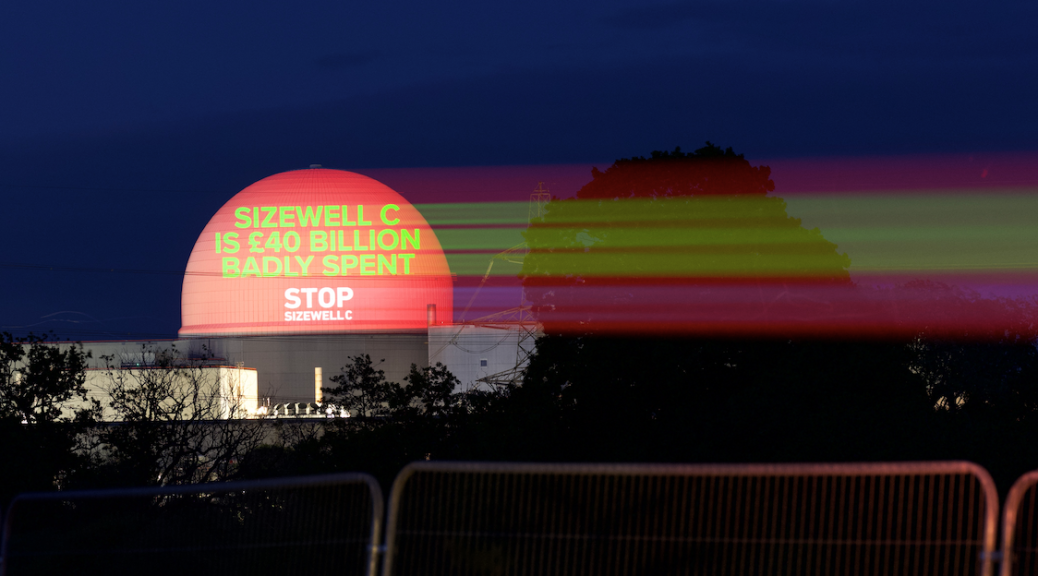
June 2026: A year on from the government’s announcement of its £14.2bn investment paved the way for a Final Investment Decision, Stop Sizewell C is publishing a report “Sizewell C – The Unanswered Questions”. This highlights what is known, what it is impossible to know, and what the government continues to keep secret about Sizewell C. It is a story of secrecy, obfuscation and deception and contains a number of recommendations. [2]
Read here: Sizewell C, the Unanswered Questions, (updated 15 June 2026)
Stop Sizewell C said: “Over the last decade, efforts to uncover Sizewell C’s expected cost and schedule have been met by obfuscation, secrecy and outright deception. [3] While the National Audit Office published some details that the government wanted to keep secret, [4] we now demand much greater transparency; the Sizewell C Full Business Case and Strategy and Delivery Plan must be published – unredacted – immediately.
“With households on the hook for Sizewell C, we need assurances that the government has a prepared exit strategy for when the project – which according to the NAO is already based on “big assumptions” and “significant uncertainty” [5] – goes wrong. The government’s inability to back out of HS2 shows where this project might be heading, but with Sizewell C’s “novel” financing, it would be immoral to force households to continue paying for something that might never work properly, while investors laugh all the way to the bank.
“In the cost of living crisis, consumers must be protected now and into the future from the risks of building nuclear projects. As well as assurances of increased scrutiny and Ministerial accountability for Sizewell C, we call for a commitment that RAB will never be used again for future nuclear projects. Unless investors suddenly rediscover an appetite for risk – unlikely given the free ride provided by Sizewell C’s RAB – abandoning nuclear or switching to full state funding would seem to be the only alternatives.
“We look forward to the outcomes of the Public Accounts Committee’s enquiry into Sizewell C and hope the Committee calls out the government for failing to come clean about this deeply flawed project.”
Notes
1. The Public Accounts Committee took oral evidence on Sizewell C on 8 June with senior officials and Nigel Cann https://committees.parliament.uk/work/9713/sizewell-c/
2. See Appendix below. Some of our recommendations echo those by the National Audit Office in its report on Sizewell C.
3. Our report includes examples such as:
-
The government claimed not to “recognise” a cost of Sizewell C put at “close to £40bn” by the Financial Times in January 2025, when in July the project “baseline” was given as £38bn and HMG’s “central cost estimate” as £40.5bn.
-
Ministers are keeping the target completion date secret, saying only “mid to late 2030s”, but the NAO revealed the project baseline date as July 2039.
-
Sizewell C revised its May 2020 cost estimate of £20bn a few months later, including removing allowances for in risk contingencies, but told the Planning Inspectorate in January 2021 the estimated cost “remains the same”.
-
Officials gaslit Stop Sizewell C in a conversation about the project costing over £30bn.
4. Stop Sizewell C has repeatedly called for publication of the Sizewell C Full Business Case (FBC) but the government decided to only publish a summary. The NAO had sight of the FBC in preparing its report, but the FBC itself is still unpublished.
5. NAO’s press statement says: “This novel approach [RAB financing] has costs and relies on big assumptions” and “DESNZ’s modelling of [Sizewell C’s] benefits shows they will not outweigh the costs to consumers until after 2060. They are also subject to significant uncertainty.”
Appendix: Our recommendations.
I. GREATER TRANSPARENCY
-
We call for the immediate unredacted publication of Sizewell C’s Strategy and Delivery Plan that contains clear and accessible information about cost, schedule and project milestones to enable the public to understand project progress. Annual updates to Parliament should spell out the following:
- Average and total costs for domestic and business users to date.
- Total capital accessed by the project to date.
- Updated construction cost compared to project baseline, LRT and HRT.
- Transparency about the whole life cost of the project from inception, through construction, operation and decommissioning. The cost of risk shouldered by HMG should also be included.
- If the Strategy and Delivery Plan cannot be published at this time the government should make a statement explaining why and commit to a publishing date.
-
We call for the immediate – unredacted – publication of Sizewell C’s Full Business Case, as accessed by the National Audit Office.
-
Terms agreed with EDF for use of its technology should be placed in the public domain.
II. EVIDENCE OF AN EXIT STRATEGY
While Stop Sizewell C is already convinced that Sizewell C cannot provide value for money or energy security, we believe the case for Sizewell C will weaken further over time as project milestones are missed, technological challenges emerge, and other sources of energy generation become cheaper. Given the financial burden on consumers, we seek assurances that the government would pursue an exit strategy rather than commit further funds to an expensive, unreliable energy source that would add to the UK’s stockpile of nuclear waste. The lack of an exit strategy must surely be a fundamental learning from HS2 – and Hinkley Point C.
-
DESNZ should publish a process and timetable for regular reviews of the FBC, including ongoing assessments of internal or external developments on the economic viability of the project. These updates should be made public.
-
These updates should transparently communicate the cost of continuing Sizewell C compared to the cost of abandoning the project, and what and when a government exit strategy would be pursued, to save consumer money being wasted.
III. PROVIDE CONSUMERS WITH ASSURANCES OF SCRUTINY AND PROTECTION
-
We echo the NAO’s call for close, ongoing scrutiny by Ministers and independent watchdogs of consumer risk. The government must provide clarity on how this scrutiny will be undertaken, and demonstrate that DESNZ is resourced with the right skills and expertise to ensure full oversight. The government should undertake an early review of Sizewell C’s governance and assign specific Ministerial accountability for the project.
-
The government should make a commitment not to use RAB for future nuclear power developments, especially GW nuclear projects. Full state funding would seem inevitable.
-
The policy decision to “recycle” the government’s profit from Sizewell C’s RAB during construction (and operation, assuming the government kept its share) to help reduce consumer contributions towards Sizewell C should be legislated, to reduce the likelihood that future governments would rescind this arrangement and force consumers to pay even more for Sizewell C. (See point 3.)
-
DESNZ should provide more detailed information to show how private sector expertise will be garnered from investors, and the basis of their belief that this will deliver savings for the benefit of consumers and that would justify use of the RAB.
-
With investor returns during construction considered “high” by the NAO, we call on Ofgem to use all its powers to limit the profits investors would receive during operation, and not be swayed by investor claims that returns should reflect their “higher risk” * – when in fact consumers are bearing significant risk.
*Comments made by Centrica in a video presentation, https://www.centrica.com/investors/centrica-as-an-investment/investing-for-value-at-sizewell-c/
Featured Image, projection onto Sizewell B dome by Stop Sizewell C, June 2026.