All posts by Alison Downes

Stop Sizewell C press coverage, DCO decision 20 July2022

Our resolute reaction to the DCO decision was quoted by:
The Guardian
The Financial Times,
The Daily Telegraph,
The Times,
The Independent,
Daily Mail
Daily Express
Associated Press (picked up by other press)
BBC online news,
Sky online news,
City AM
East Anglian Daily Times,
ITV Anglia online & feature “How Will Sizewell C change Suffolk?”

as well as local radio and TV news broadcasts and multiple industry publications.

Sizewell C planning decision rammed through against Planning Inspectorate concerns

Sizewell C is controversially approved planning consent despite Planning Inspectorate recommending refusal

Contact: Alison Downes, 07711 843884 (WhatsApp), 01728 831099, alison@stopsizewellc.org.

20 July, Suffolk. Campaigners vow to fight on against the controversial Sizewell C project despite Ministers overruling the Planning Inspectorate, who had recommended it should NOT receive planning consent. The Planning Inspectorate had cited uncertainty of water supply and impacts on protected species and habitats as well as multiple other negative impacts. [1]

Stop Sizewell C said: 

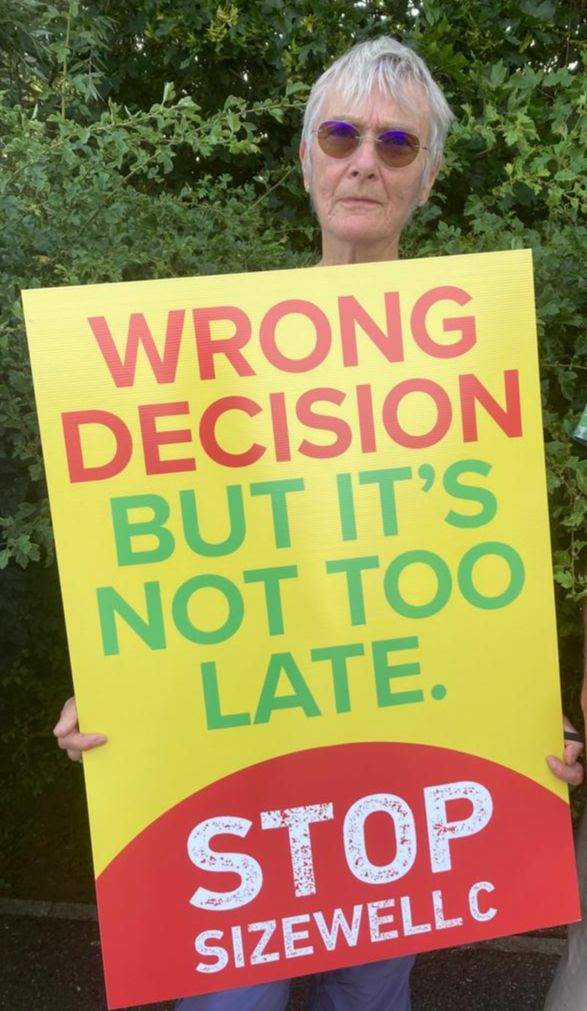
“The government has been forced to ram through a damaging project to shore up its energy strategy but the fact that the Planning Inspectorate recommended Sizewell C be refused consent is a huge victory for all of us. The wrong decision has been made but it’s not the end of our campaign to Stop Sizewell C. Not only will we be looking closely at appealing this decision, we’ll continue to challenge every aspect of Sizewell C, because – whether it is the impact on consumers, the massive costs and delays, the outstanding technical questions or the environmental impacts – it remains a very bad risk.“

What’s left of Boris Johnson’s administration should desist from throwing any more cash at Sizewell C or making a Government Investment Decision. It’s deeply concerning, given that households will have to pay for this massively expensive project in times of such hardship, that no one in government is prepared to come clean about how much it will cost to build. [2] How can it be a good use of UK taxpayers funds to support a project promoted by a foreign company having to undergo emergency nationalisation because its own finances are compromised by disastrous nuclear new builds?” [3]

“The political events of recent weeks prove just how quickly things can change, so we are ready to take this seriously flawed project on.”

Campaigners had urged Ministers to delay both the planning decision and any Government Investment Decision [4] until a new Prime Minister is in place. The change in leadership provides an important opportunity for a policy review, especially given this week’s successful legal challenge of the Net Zero Strategy. [5] The preoccupation among leadership candidates with tax cuts and halting green levies on bills [6] is inconsistent with Sizewell C, which would require a nuclear tax on consumers to help meet financing costs during construction, and where build costs, risk and timeframes are high, and difficult to accurately predict. A new Prime Minister and Cabinet should not have their hands tied by a white elephant.

BEIS was forced to farm the decision out to another department after Paul Scully was moved to the Department for Levelling Up, Housing and Communities on 7 July. The Business Secretary of State and Energy Ministers were unable to make the decision due to their promotion of the project.  Campaigners have expressed concern at the potential for bias and predetermination. [7]

Notes

  1. See https://infrastructure.planninginspectorate.gov.uk/projects/eastern/the-sizewell-c-project/
  2. BEIS’s own RAB financing Impact Assessment shows that the cost of a notional power station could be £26 – £43bn with construction times of 13 – 17 years. BEIS has refused to publish a revised cost estimate for Sizewell C but has applied an undisclosed “appropriate uplift” to EDF’s figure of £20bn.
  3. EDF’s parlous financial situation is in part due to Hinkley Point C: its latest cost estimate of £25-26bn (£29.7 – £30.9 billion in 2022 money) is a 38% – 45% increase on the £18bn cost at Final Investment Decision (2016), with 5 years of construction to go. EDF is on the hook for these overruns as China General Nuclear has no obligation to put in any more money than contractually agreed (a 33% share of £18bn). EDF’s Universal Registration Document states (p13): “As the project’s total financing needs exceed the contractual commitment of the shareholders, shareholders will be asked to provide additional equity. This could lead the Group to increase its contribution to the project financing and to increase its stake (currently 66.5%) if its partner [CGN] decided not to contribute to these additional equity commitments’. The French state – with ambitious plans of its own for nuclear power – may have different priorities than Sizewell C.
  4. A planning decision could be followed by further taxpayer-funded financial support for Sizewell C, and possibly a Government Investment Decision, which would confirm a 20% stake in £7 billion of equity (also reported to be £8 billion) alongside 20% stake by EDF, leaving £4 – 5billion in equity to find. The remainder would be debt. 
  5. In a case brought by Friends of the Earth, Client Earth and the Good Law Project, the High Court ruled that the Net Zero Strategy “doesn’t meet the government’s obligations under the Climate Change Act to produce detailed climate policies that show how the UK’s legally-binding carbon budgets will be met…. the government will have to update its climate strategy to include a quantified account of how its policies will achieve climate targets, based on a realistic assessment of what it actually expects them to deliver.”
  6. Eg “The foreign secretary suggested she wanted to look again at policies aimed at achieving the net zero target, vowing to stop the levies which help pay for investment in renewable energy.” 
  7. BEIS confirmed “the Secretary of State will have no role in the decision-making process on the application for development consent (although the decision will be made in the name of ‘the Secretary of State’) due to his involvement in decisions on possible government funding (see reply from the Secretary of State’s Private Office to 36 East Suffolk Parish Councils, June 2022. Kwasi Kwarteng told ‘Today’ on 7 April “we are committed to Sizewell C” and Boris Johnson told BBC Radio Suffolk “we want Sizewell C”. 


6 reasons why Sizewell C is still a bad idea and not a done deal


  1. Wrong project, wrong place. The RSPB opposes Sizewell C, saying “the likely impact of this particular project could be very damaging. The Suffolk Wildlife Trust is also opposed to Sizewell C. Six hectares of Sizewell Marshes SSSI will be lost forever. Compensatory habitats take decades to establish and may not replicate what is lost. Sizewell C has still not secured a source for 2.2 million litres/day of operational potable water. Flooding, coastal erosion and sea-level rise are concerns on Suffolk’s fast-eroding coast. Sizewell C’s coastal defences would protrude 20m seaward compared to the natural coastline. It will be unsustainable and a threat to the rest of the coast following Sizewell B’s permanent shutdown. Spent fuel would sit on the site for at least 115 years even if a Geological Disposal Facility is built. Suffolk has poor transport infrastructure and EDF has refused to delay starting work on the main construction site until the required new roads are ready. HGV movements are expected to peak at 700/day. East Suffolk has a diverse local economy supported by SMEs and tourism, but the biggest building site in Europe, its traffic and 76% external workforce would destroy existing jobs by driving visitors away and displacing workers from existing businesses. The Suffolk Coast Destination Management Organisation estimates £40m a year of lost tourism income. Sizewell C won’t help ‘level up’ the UK. Sites in the north and west would do more to narrow the economic gap. Of Sizewell C, Lord Deben said: if you believe in levelling up, it’s ridiculous to put it in a place of high employment”.


  1. Too Slow and Expensive: BEIS refuses to publish an updated cost estimate for Sizewell C but acknowledges it will cost more than stated by applying an undisclosed “appropriate uplift” to EDF’s figure of £20bn. BEIS’s Impact Assessment, published with the Nuclear Energy (Financing) Bill, for a notional power station, contains cost ranges of £26.3bn to £42.8bn with construction times of 13 – 17 years. In June CCC Chair Lord Deben saidEDF has still got two nuclear power stations which aren’t finished…So there’s a real concern with people about how qualified these people are to do these things.” 


  1. Consumers carry the (greenwashed) can: Sizewell C would burden consumers and the national budget – at exactly the wrong time for both. Many big (Energy Intensive) companies will be exempt from RAB payments, but poorer families, even those on Universal Credit, will not. The government plans to lure pension funds to invest by re-labelling nuclear as “green”. A Treasury consultation is expected after the summer recess.


  1. Not a proven technology. One of the only two operating EPRs, at Taishan in China, has been closed since 31 July 2021 with fuel failure and “hydraulic stresses” (p116). Olkiluoto in Finland is still in testing mode with delivery of electricity to the grid delayed again until December. Flamanville, in France, is still under repair with fuel loading Q2 2023 at the earliest. 


  1. Not British, not secure and not needed: Sizewell C would have a foreign reactor design, foreign developers, foreign operators and probably owners, and rely on foreign-sourced fuel. The claim of ‘home-grown’ nuclear is totally misleading. By the time this behemoth project may be completed, at enormous expense, the UK’s energy landscape will be profoundly different, favouring cheaper green energy and green hydrogen. Every pound invested in Sizewell C is a pound diverted from other sources. Multiple future energy scenarios, including three of five by the Climate Change Committee, and National Grid ESO’s “Leading the Way” do not include Sizewell C. New reports reveal how Energy Efficiency could save six nuclear reactors’ worth of power and energy demand in the UK could be reduced 52% by 2050 without compromising on quality of life.


  1. Still hurdles to overcome. Sizewell C still needs a site licence and environmental permits. The Environment Agency is running a public consultation on environmental permits from 4 July to 25 September. Secondary legislation is needed for use of RAB for Sizewell C. A Final Investment Decision is expected mid 2023.

Reaction: Secretary of State publishes draft designation reasons for Sizewell C Co.

BEIS has today published draft reasons for designating NNB Generation Co (Sizewell C Co) as the first step towards the company being able to use a RAB funding model. All financial figures have been redacted. The BEIS press statement says “by publishing the draft reasons for designating Sizewell C under the RAB model, the government is going beyond the transparency requirements set out in legislation.”
Stop Sizewell C said: “It’s outrageous that ministers are hiding the cost to electricity bill payers and the public purse of Sizewell C, while claiming to be transparent. By redacting the finances, it is impossible to know if the Secretary of State’s judgement on Value for Money is sound. We fail to understand why the government would not impose conditions related to the EPR reactor technology, when it has such a catastrophic track record, and one of the only working examples has been offline for almost a year in China”
Additionally we note the following:
  • The Secretary of State is intending to designate a company which no one knows who the owners will be. EDF and the government – both apparently intending to be minority partners in Sizewell C with 20% stakes – are continuing to negotiate with each other behind closed doors. The government intends to take a special share in Sizewell C, as a means of “protecting national security interests”, yet there is no mention of removing China General Nuclear from the project.
  • The Value for Money assessment acknowledges that the (secret) figures provided by NNB require “uplift” (page 22 “Given that largescale infrastructure projects have a tendency to cost more and take longer to build than expected, the analysis has applied appropriate uplifts to these assumptions”), and conclude that “the estimated return on government investment is positive in the majority of scenarios modelled” (page 22). With no indication of the size of that majority, or the various cost burdens, it is therefore clear that the return was negative in at least some scenarios. The only cost for Sizewell C in the public domain is the original estimate of £20 billion, published over two years ago. Since then there have been major changes to the project and huge price hikes in construction materials.
  • Despite references to lessons learned at other EPR projects, there are no specific conditions linked to design adaptations that will be required for Hinkley Point C and Sizewell C’s reactors based on the experience of Taishan 1, where problems have led to the reactor being offline for almost a year. (EDF reports, p116 “In addition [to fuel failure], a phenomenon occurring between the assemblies and a component enclosing the core has been identified, which would be linked to hydraulic stresses”  and the French regulator, ASN, refers to (p14) “various anomalies observed on the cores of the EPR reactors of TaishanSuch adaptations could have a serious impact on both cost and timescales. A government condition was attached to an (unused) offer of loan guarantees for Hinkley Point C, that the Flamanville EPR should be operating by December 2020. It is not expected to be operating until mid 2023 at the earliest. Finland’s Olkiluoto EPR is still testing at reduced capacity.
  • The government’s Dynamic Dispatch Model (DDM) methodology is secretive. The modelling should be made public and subjected to proper scrutiny by informed people in order to build the private investor confidence the project requires. Neil Crumpton of PAWB says “The DDM model is too technically and economically simplistic and not sufficiently transparent for robust engineering decision making, due diligence or public scrutiny. Decisions on multi billion projects should not be based on anything like such basis”. 
  • The document contains a number of statements we consider to be prejudicial to the DCO (planning) process, despite the Secretary of State’s claims that another BEIS minister will make that decision, due by 8 July. eg para 134: “The construction of Sizewell C is also expected to have adverse effects on ecology, fisheries and marine water quality. However, some effects will be reduced dependent on successful establishment of replacement habitats. Suffolk County Council, SZC GenCo and East Suffolk Council have agreed a funding package for mitigation and compensation measures in a Deed of Obligation, which includes up to £100m for the environment.”
  • If the Secretary of State wanted more transparency, the legislation provides the option to consult “any other person” but he has rejected this opportunity, limiting the consultation very narrowly to a small group of statutory consultees. Not even the relevant Local Authorities are included. Local communities are dismissed on the grounds that they have been extensively consulted during the DCO process, yet BEIS is well aware of multiple complaints about the poor quality of EDF’s consultations. The government has however published a public consultation on the detail how of how nuclear projects would receive their funding under the RAB model.
  • A reference to Sizewell C contributing to the government’s target of 2 million “green” jobs pre-judges the outcome of a promised UK consultation on the taxonomy of nuclear energy.
  • The BEIS press statement reiterates a claim that a RAB model for Sizewell C would cost consumers on average a pound a month, a figure that has been challenged by Stop Sizewell C working with Professor Steve Thomas, see https://stopsizewellc.org/rab.
  • There are no references to or conditions attached to lessons learned from Ukraine where nuclear sites have been targeted during the conflict.